
A way out of stuckness:
Nervous System Regulation - A Guide Beyond ‘Calming Down’

Stuck. This is the state most of our clients find themselves in when reaching out to us for somatic therapy. Stuck in patterns of anxiety, shutdown, exhaustion, emotional reactivity, people pleasing, procrastination, overthinking, interpersonal conflicts… The list goes on.
As if it weren’t enough, on top of that, there’s often a sense of frustration, helplessness and sometimes even guilt or shame for not being able to change it.
The first step out of this loop is recognising what this stuckness is, and what it’s not, from a somatic perspective.
It is nervous system dysregulation. Your autonomic nervous system and your body are locked in survival patterns, trying hard to protect you from perceived threat.
It’s not an inherent personality flaw or weakness, but an attempt of your system to cope with overwhelm.
Many people with childhood trauma or chronic stress patterns experience this without realising their body is doing its best to protect them.
In this guide, I’ll walk you through what nervous system dysregulation is, why you may feel stuck, and why relaxation alone might not be enough. I’ll also explain how Somatic Experiencing supports nervous system regulation and offer simple practices you can try on your own.
Understanding Your Autonomic Nervous System
Healing starts with understanding, so here’s a brief and simple overview of the autonomic nervous system and how it works.
The autonomic nervous system (ANS) governs our automatic physiological functions such as heartbeat, breathing, digestion, reproduction, etc. It has two main branches: the sympathetic and its mirror opposite, the parasympathetic branch. Think of them as a gas pedal and a brake pedal.
The sympathetic branch mobilises us for action or protection, while the parasympathetic branch slows our system down so we can rest or disconnect.
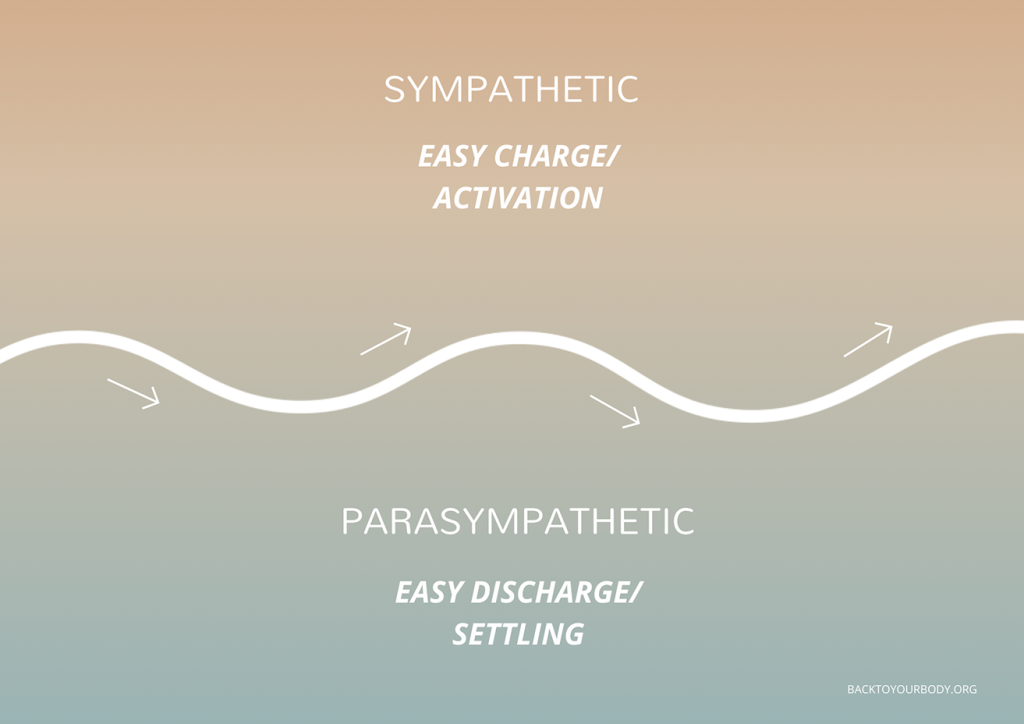
When the system is safe and resilient, it fluctuates between sympathetic activation and parasympathetic settling following the rhythms of the day, seasons, hormonal cycles and other phases of life. It is never static, and it’s meant to be flexible and adaptive.
Regulation & Dysregulation
When we are experiencing stress, and the wave of sympathetic activation increases, it turns on our protective fight, flight or freeze responses. And once the stressor is gone, a resilient nervous system will eventually settle. It will find its way back to the rest-and-digest parasympathetic state. This is natural regulation – an adaptive capacity of a resilient nervous system to mobilise and settle as needed.
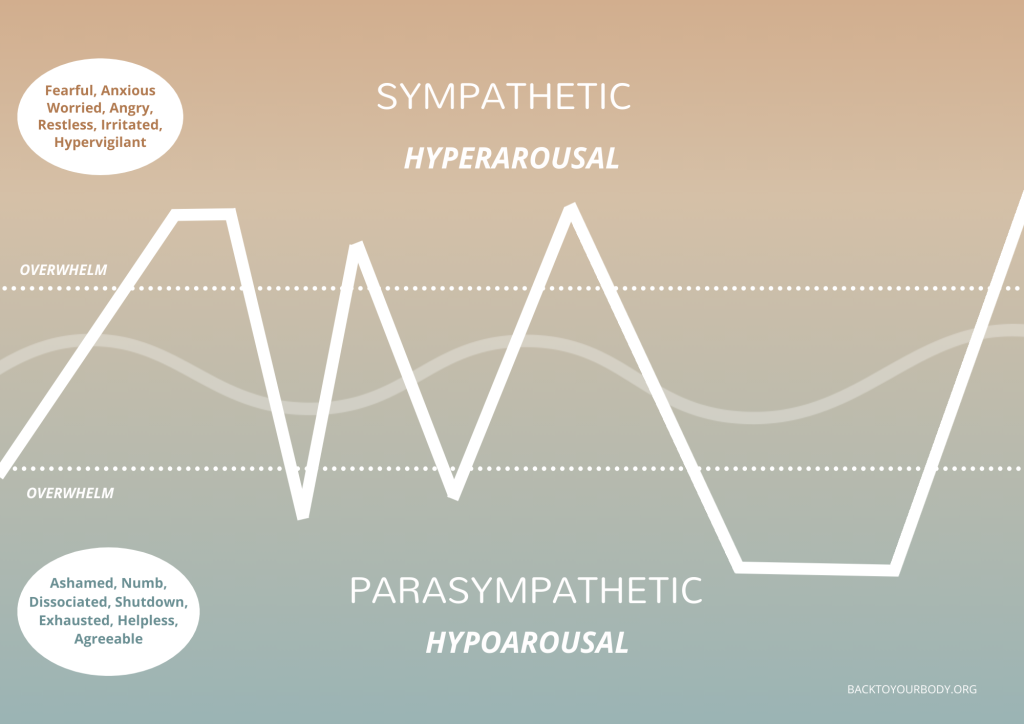
But when it comes to chronic or traumatic stress, the autonomic nervous system starts to behave very differently. When the system gets overwhelmed and is pushed way beyond its ability to cope, instead of flowing between activation and settling, it gets stuck in one of the survival states or keeps bouncing between them. This is what nervous system dysregulation is.
What Dysregulation Looks Like
You might notice this in your own body as tight shoulders, shortened breath, a racing mind, or a sense of collapse in your chest. For some people, dysregulation looks like constant worry and sleeplessness. For others, it shows up as numbness or emotional shutdown. These patterns can feel very different on the outside, but they all come from the same survival responses.
The autonomic survival responses are intelligent ways our system protects us from danger through action (to fight or flee), immobilisation and disconnection (freeze) or through defensive social engagement strategies (fawning). When the system is overwhelmed by chronic stress or trauma, it can remain in these states continuously. This may show up as:
• Constant anxiety, uncontrollable anger, high reactivity, insomnia
→ sympathetic fight-or-flight (hyperarousal)
• Numbness, fatigue, dissociation, depression, hopelessness
→ parasympathetic freeze or shutdown (hypoarousal)
• People pleasing, difficulty saying no
→ mixed sympathetic–parasympathetic fawn or appease
However, as Deb Dana beautifully points out, “no matter how the nervous system has been shaped, the capacity for moving out of protection and returning to connection is built into our biology.”
Regulation vs. Relaxation
But before we get into ‘how’, let’s clarify a few terms that are frequently confused and used interchangeably – regulation and relaxation. It is important to note that they are not the same.
Regulation means having the capacity to move between activation and settling – getting mobilised when appropriate and being able to rest when needed. Being regulated does not mean staying calm all the time. It means having a flexible nervous system.
Self-regulation supports this flexibility.
Relaxation, on the other hand, refers to settling or downregulation of the nervous system that connects us to the restful parasympathetic state. It is one aspect of nervous system regulation, not all of it.
For many folks who are stuck in the patterns of hyperarousal, introducing relaxation techniques offers a much-needed relief. But for someone stuck in the hypoaroused state of disconnection and shutdown, a tolerable amount of safe stimulation or upregulation can help them move out of the protective (dorsal vagal) parasympathetic state.
The purpose of relaxation tools is to break the fixed pattern of high arousal in the moment. It is also an important first stage of any trauma work. Yet this is not the end goal of nervous system regulation support.
Regulation, especially in trauma healing, also means reconnecting with your aliveness and strengthening the capacity to stay present with your experience.
Somatic Experiencing Approach To Nervous System Regulation
While there are numerous practices that can help you relax or downregulate (yoga nidra, restorative yoga, craniosacral therapy, reiki, calming breathwork and many more), Somatic Experiencing (SE) is the trauma healing method that supports both short-term and long-term regulation through safe connection to the body that fosters greater resilience. It emphasises that healing happens through safety, attunement and relationship, not through forcing yourself to calm down.
Here’s how the SE approach supports regulation:
Honouring the complexity
When addressing nervous system dysregulation that has occurred as a result of chronic stress and trauma, we need to be aware of the complexity of the physiological traumatic adaptations.
Because of this complexity, even simple breathing and relaxation techniques, depending on a particular person’s physiological adaptations, sometimes may feel more dysregulating than soothing. It means not all self-regulation techniques will work for everyone, not to the same degree or not all the time.
Because of this complexity, Somatic Experiencing relies less on a fixed protocol, but more on tracking the individual nervous system and meeting it where it is at any given moment.
Cultivating Safety
Rather than just focusing on any specific downregulation or upregulation tool or practice, SE prioritises safety.
Steven Porges, the developer of the polyvagal theory (external link), emphasises the importance of safety in nervous system work:
“If our nervous system detects safety, then it’s no longer defensive. When it’s no longer defensive, then the circuits of the autonomic nervous system support health, growth, and restoration.”
Even though the concept of safety can be tricky for trauma survivors, Somatic Experiencing works with whatever small, accessible sense of safety is available in the here and now. This is facilitated through:
• practitioner’s regulated presence and the rapport built with the client,
• the principle of ‘titration’, i.e. taking one step at a time at the pace of the client’s nervous system;
• by ensuring that the client has enough internal and external resources before doing any deeper nervous system work.
Practicing Self-Attunement
Nervous system regulation is not about changing your state through effort, but about attuning. Deb Dana calls it ‘autonomic listening’, which is linked to self-compassion – a ventral vagal property of the autonomic nervous system.
Every time we attune to our autonomic nervous system’s state with curiosity, non-judgment and understanding of its protective nature, we activate the ventral vagal parasympathetic branch and its regulating function.
In Somatic Experiencing sessions, we practice attuning to our states by tracking bodily sensations and noticing subtle shifts that start to happen as a result – a sign that the nervous system gets out of the fixed state it has been stuck in.
Completion of what didn’t get to happen
As we cultivate and strengthen the internal felt sense of safety and practice attunement, the body starts to open up and reveal what is held inside, creating a possibility for an even deeper layer of nervous system and trauma healing.
In the context of chronic dysregulation and trauma, Somatic Experiencing helps to come out of the survival loop by allowing the body to complete “what wanted to happen but didn’t get to happen”. It could be an experience of successful fight or escape, vocal expression, protection, or safe connection with another human, to give you just a few examples.
This missing or corrective experience can be introduced through visualisation or somatic exercises and by following bodily impulses and movements and is usually guided by an experienced practitioner.
Expanding the window of tolerance
Another crucial aspect of nervous system regulation support is gradually building the capacity to tolerate life stressors without getting flooded and overwhelmed. In other words, expanding the ‘window of tolerance’, sometimes also referred to as the window of capacity or resilience.
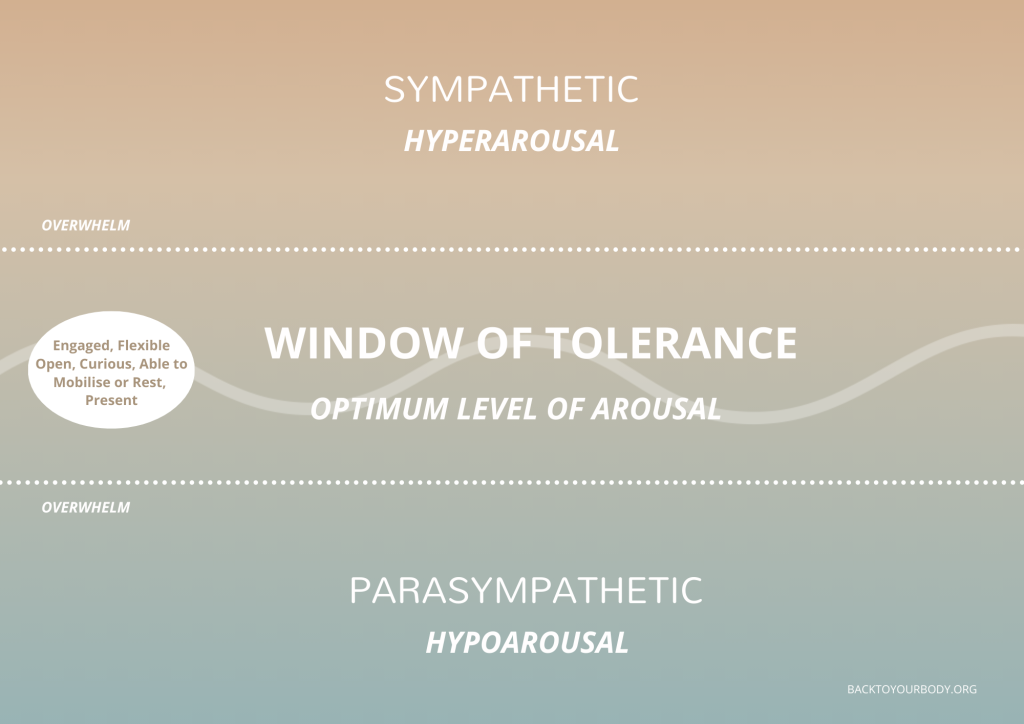
As a result of trauma, our window of tolerance can get very narrow so that even mild activation can push us into overwhelm and dysregulation. While we can’t avoid activation and stress completely, we can teach our system to be less reactive using the SE principle of titration. It allows us to tolerate activation in small doses, giving time for the nervous system and the body to re-adjust and register that there’s no life threat, and it is safe to feel.
This helps to build inner resilience, so we can ride the waves of activation rather than being thrown around or swallowed by them.
Everyday Ways to Support Regulation
While trauma-related dysregulation often requires help from a trauma specialist, there are many ways you can start supporting your nervous system on your own. Here are some simple somatic exercises that help find safety in the body and in the present moment:
1. Finding Resources - Small Moments of Safety
This practice is about finding something in your environment that feels good to look at – a colour, an object, a texture, or even the way light reflects off a surface. Let your eyes rest on it and notice what happens inside: does anything soften, relax, feel lighter, or just a tiny bit calmer? If you feel even a slight positive shift, that’s a resource – something that brings a sense of safety or ease into your body in the present moment.
2. Grounding Through Your Feet
Grounding helps you get out of your head and into your body in the here and now. Take a moment to feel your feet – wiggle your toes, press them into the floor, or explore different surfaces if you’re barefoot. Notice the texture, temperature, and how your breath feels as you do this. Exploring slowly and with curiosity helps you reconnect with physical sensations in a way that is supportive rather than overwhelming.
3. Using Touch to Feel Your Body as a Safe Container
Touch helps you sense the boundaries of your body and reconnect with yourself when you feel numb, overwhelmed, or overstimulated. Try gently tapping your arms, torso, legs, or feet, or add gentle pressure and massage to feel deeper layers of support. You can also place your hands somewhere that needs attention or give yourself a self-hug. Move slowly and allow your body time to register touch as safe.
4. ‘Voo’ Breathing - Using Sound to Settle Your System
Voo breathing is a simple way to stimulate the vagus nerve and support the ventral parasympathetic state. Take a slow breath in through your nose, and as you exhale, make a deep, long “voo” sound like a foghorn. Feel the vibrations move through your chest, belly, or even limbs. For many people, this is grounding and calming; for others, it can feel gently energising. Always notice how your system responds and adjust at your own pace.
5. Mindful Movement - Reconnecting With Sensation and Flow
Mindful movement helps you befriend your body slowly and gently, especially if stress or trauma has created resistance to movement. Simple, deliberate movements can help awaken physical sensations, release stuck energy, and bring you back into the present moment. Even a short yoga sequence or a peaceful walk outside can help you feel more grounded, alive, and connected to your body with clarity and ease.
You can download my free e-book, Self-Regulation 101, to follow these exercises and more detailed explanations on your own whenever you need.
When to Seek Professional Help
If, however, dysregulation feels too strong and unmanageable, consider reaching out for support. You don’t have to do it alone.
Different degrees of dysregulation require different types of support, which may include working with a licensed mental health professional.
Somatic Experiencing, a form of somatic trauma therapy, is a complementary approach within this larger landscape. It bridges dialogue, mindful awareness and body-mind tools, helping gradually come out of the dysregulation loop through the body. If you feel drawn to it, you are welcome to explore it with us.
Closing Thoughts
And just a final reminder that if you are stuck in a pattern of dysregulation, healing is not about fixing yourself. It’s about building a different kind of relationship with your nervous system. It is this relationship and connection that opens up possibilities for more aliveness, presence and more choices.

I’m Elena Jacinta, a Somatic Experiencing practitioner and the founder of Back To Your Body, an online somatic therapy practice offering a supportive space to attend to your nervous system and trauma through the body. At Back To Your Body, we help individuals and couples with nervous system regulation, psychosomatic symptoms, shock trauma, developmental/ attachment trauma, systemic and generational trauma.